

When Earnings Speak Louder Than Headlines
A few weeks ago, we wrote about The Effects of Geopolitical Events on Markets, and shared a simple but important idea: markets react to headlines quickly, but they ultimately price in earnings and economic impact, not news alone. We noted that when the ripple effects on the real economy are limited, history shows that reacting with patience has often led to better outcomes than reacting to short-term panic.
At the time, that framework was a lens for looking forward. Operation Epic Fury had disrupted roughly 20% of the global oil supply through the Strait of Hormuz, energy prices had spiked, and markets were unsettled. The question we posed was whether this crisis would be one of the more economically disruptive kinds, like the Yom Kippur War, or one that the market would eventually move past.
Now, about a month later, we have a clearer picture. And it's a good opportunity to look at how that principle has played out in real time.
From late February through the end of March, markets traded lower on the uncertainty. The S&P 500 bottomed in late March, capping a pullback that felt sharper in the headlines than in the actual numbers. Then, once a tentative ceasefire was announced in early April, sentiment shifted quickly. Major indexes staged a strong rally, and by mid-April, the S&P 500 was back to all-time highs.
If you had tuned out the news for six weeks, checked your statement, and then looked again, you might have wondered what all the concern was about. That's not unusual. It's exactly the pattern the LPL data we shared last month described: a fast reaction, a short drawdown, and a recovery that often begins before the news feels resolved.
But the more interesting story isn't what prices did. It's what's underneath them.
Earnings Didn't Just Hold Up — They Got Stronger
Here's what caught our attention. Heading into the first quarter of 2026, analysts expected S&P 500 companies to grow earnings by 13.2% compared to the same quarter last year, according to FactSet. That was already a healthy number. What's notable is that expectations rose, not fell, as the conflict unfolded, a pattern that stands in contrast to how earnings estimates typically behave during periods of stress.
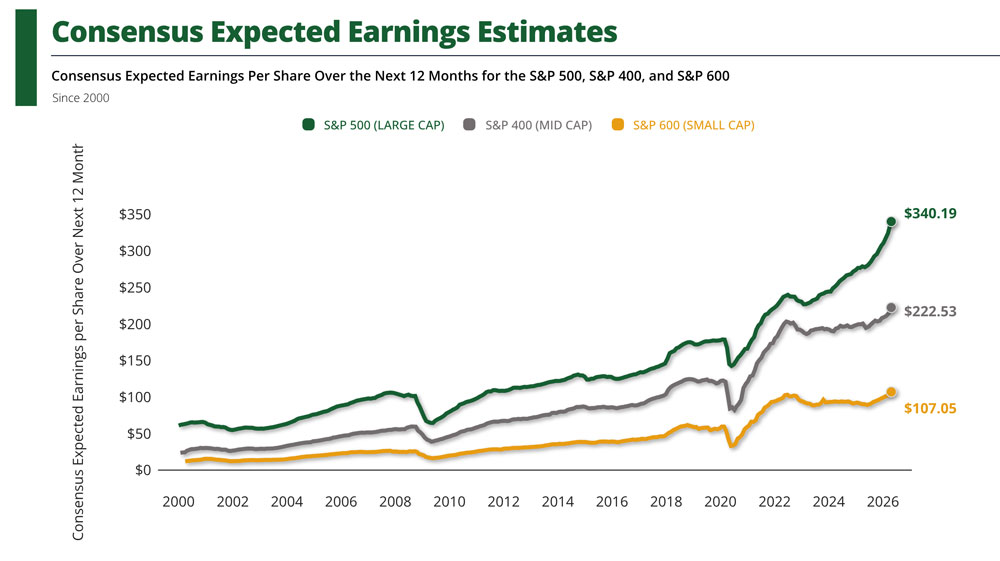
Source: © Exhibit A, FactSet Research Systems Inc., Standard & Poor's | Latest: 2026-04-22
And early results have exceeded even those raised bars. According to FactSet, of the S&P 500 companies that have reported first-quarter results so far, 88% have come in above estimates. That's well above the five-year average of 78% and the ten-year average of 76%. On a dollar basis, companies are reporting earnings roughly 11% above expectations, again well above the typical level.
Looking further out, analysts are currently projecting double-digit earnings growth for every remaining quarter of 2026, with full-year earnings growth estimated at roughly 18%.
This matters because, as we wrote last month, markets are forward-looking. They don't price what is; they price what's expected. When earnings expectations are rising rather than falling, the market has something concrete to stand on, even when the headlines are difficult.
A few factors lined up in a way that softened what could have been a more damaging scenario.
First, the conflict, while serious, ended with a ceasefire before oil disruptions worked deeply into corporate costs. Prices spiked, but they didn't stay elevated long enough to fundamentally reset margins across the economy.
Second, the sectors that matter most to current earnings growth, particularly technology, are relatively insulated from energy costs. Artificial intelligence-related capital spending has continued to accelerate, supporting earnings for the index's largest companies. Financials have also held up well during the period.
Third, corporate profit margins entered the quarter at historically strong levels. Companies had room to absorb some cost pressure without passing it all through to consumers or their bottom lines.
None of this was guaranteed going in. We noted last month that oil-driven crises historically have bigger economic ripples, and that risk remains real. What we're seeing now is the other side of that same coin: when the ripples turn out to be contained, the recovery can be faster than the headlines suggest.
The Lesson Isn't "Don't Worry"
We want to be careful here. The point of this reflection isn't that concern was misplaced, or that geopolitical risks are ever trivial, because they aren't. The point is that the framework we described in March, looking past headlines to the underlying economic impact and the direction of corporate earnings, gave us something useful to hold onto during a period when the news felt overwhelming.
In this instance, investors who remained invested experienced the subsequent recovery, while those who exited during the decline risked missing it. People who reacted to the headlines and stepped away risked locking in a loss and missing the rebound. That's not a prediction about future events; it's simply what happened this time, and it's consistent with what the historical data has shown over decades.
Markets will face more geopolitical tests. There will be more headlines that make your stomach drop when you open the news. The specifics will change, but the framework doesn't have to.
Watch the earnings. Watch the economic ripples. Give the market time to price what actually matters rather than what feels most urgent in the moment. And remember that the plan you've built isn't designed to avoid storms; it's designed to weather them. Storms are temporary. A well-built financial plan is not.
If the last several weeks left you feeling uneasy about your portfolio, that's worth a conversation. Not because something is wrong, but because understanding why your plan held up is often what makes it easier to stay with it next time.
~ Steve Gormley
Certain statements herein may be forward-looking and are based on current expectations and assumptions. Actual results may differ materially due to market conditions and other factors.
Any market or economic data referenced is based on information believed to be reliable as of April 2026 but is not guaranteed as to accuracy or completeness. Source: FactSet Earnings Insight, as of April 2026.
All performance referenced is historical and is not indicative of future results. Market conditions are subject to change. Indices are unmanaged and cannot be invested into directly. Index performance does not reflect the deduction of advisory fees, transaction costs, or taxes.
Investing involves risk, including the potential loss of principal. Diversification and asset allocation strategies do not guarantee profits or protect against losses in declining markets.