

The Effects of Geopolitical Events on Markets
You open the news, see another conflict unfolding, and your first instinct is to check your portfolio. You're not alone! When geopolitical tensions rise, it's natural to worry about your investments and to expect the worst. But here's what's worth knowing: history tells us a different story. Time and again, markets have weathered these moments better than the headlines suggest. So instead of speculating on what might happen, let's look at what actually has.
What the Record Shows
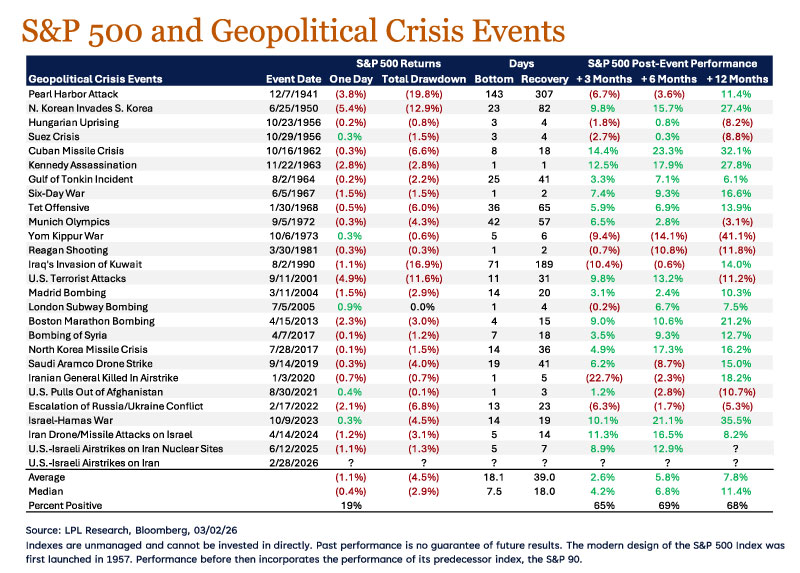
The table above, provided by LPL, shows select Geopolitical Crisis Events dating back to the attack on Pearl Harbor in 1941. It clearly shows the wide range of effects that geopolitical events can have on markets. Let’s focus on the median values, since averages can be distorted by outliers. The table shows that the median one-day return is -0.4%, while the median total drawdown is -2.9%. This supports the idea that markets react quickly to negative news without accounting for the real economic implications. In line with the usual reaction to these events, the median time to the bottom is 7.5 days, while the median recovery is 18 days. Roughly 2/3 (68%) of the time, the market is up one year later; the median market return one year post-crisis is 11.4%, indicating that geopolitical shocks prompt short-term pullbacks. While bold headlines create short-term volatility, the declines are temporary. Staying the course, once again, proves to be beneficial during tumultuous times.
Not All Crises are Considered Equal
Although all geopolitical events create a similar type of angst in the market, it is quite clear that not all are equal. With post-12-month returns ranging from -11.2% to 35.5%, the impact these events have on markets is wildly different, AND for a reason. Markets immediately try to determine the economic impact (if any) and price that in. Following events like the Cuban Missile Crisis, the Kennedy Assassination, and the Israel-Hamas war, the market was pricing in direct impacts that the crisis could have on the economy. When the event does not trigger major economic impacts, such as supply chain disruptions, commodity (oil) price shocks, or trade sanctions, the market continues to press forward, as the following 12-month returns post-crisis have shown. However, some crises are associated with larger drawdowns due to an unfavorable investment environment. For example, 9/11, the Yom Kippur War, and the U.S. pulling out of Afghanistan had a lot more economic implications under the hood than others. In short, the market’s reaction is less about the news headlines and more about the rippling effects on the economy. When these ripple effects are limited, history shows that patience is more often rewarded than panic. So, what can this framework tell us about our current crisis?
Where does this leave us with Operation Epic Fury?
It is still too early to make any bold predictions, but the pattern is hard to ignore. History shows that conflicts in major oil-producing regions, such as the Yom Kippur and Gulf wars, have historically triggered commodity price shocks, leaving lasting effects on the economy. For example, the Yom Kippur War triggered an oil embargo that spiked energy prices and ultimately led to a period of stagflation. The market took 5 days to bottom and 6 days to initially recover, but stagflation pressures led to a -41% return over the following year. With Operation Epic Fury disrupting roughly 20% of the global oil supply, the economic ripple effects could be more pronounced than events with limited commodity exposure.
Does this mean investors should brace for a longer, steeper drawdown? Maybe. However, remember, history shows that even oil-driven crises eventually recover. Not because geopolitical tensions disappear, but because economies adjust and sentiment shifts. The question isn’t whether there will be volatility, but how to weather it while staying on track with long-term goals. Understanding the mechanics behind market recoveries can help.
Why Markets Tend to Recover
Markets tend to rebound even after severe shocks due to their forward-looking nature. They price in future earnings and growth, not current issues. But fundamentals alone don’t tell the full story; investor psychology plays an equally powerful role. Investor sentiment often hits its low before the market, triggering a wave of panic selling that drives prices far below their true worth. When this happens, it acts like a pendulum swinging too far in one direction, creating opportunities for those who stay grounded. The same herding behavior that drives selloffs also fuels recoveries. While knowing this does not make the experience any easier to endure, it underscores the importance of maintaining a long-term outlook during periods of market turbulence and staying invested.
What This Means for Investors
Market downturns often resemble storms. They arrive quickly, stir up unease, and make it difficult to have a clear outlook. News headlines create sudden swings as investors try to assess economic impacts. Historically, markets react very quickly, but once an economic impact is seen as limited, a recovery often follows. Following a geopolitical crisis, markets finished positively 68% of the time 12 months after, reinforcing the idea that many geopolitical crises have temporary effects on markets rather than permanent disruptions for long-term investors. A useful takeaway for investors is that, although these events can feel alarming and dramatic in the moment, markets have historically recovered once the uncertainty fades.
Storms are temporary. Well-built financial plans are not. History has shown time and again that the investors who end up the best positioned are not those who react the fastest but those who stay the course the longest. If you have any questions or concerns about how recent events have affected your financial plan, we’re always here to help you navigate.
~ Ricardo Salinas
Source:
https://www.lpl.com/research/blog/middle-east-conflict-how-stocks-react-to-geopolitical-shock.html