

$40 Trillion: 3 Reasons the National Debt Might Affect Your Household, and 3 Reasons It Might Not
What the debt milestone does and doesn’t mean for your financial plan?
This week, the U.S. Treasury reported that the federal debt crossed $40 trillion for the first time. Clients have been asking us about the national debt for more than twenty years, through every milestone along the way, and the question is almost always some version of the same one: What does this mean for my investments?
What Matters Isn’t the Balance, It’s the Payment
If you carry a mortgage, the balance on it is not what determines whether you can afford your life. What matters is the payment relative to your income. A $700,000 mortgage on a $300,000 salary is manageable. The same balance on a $60,000 salary is not.
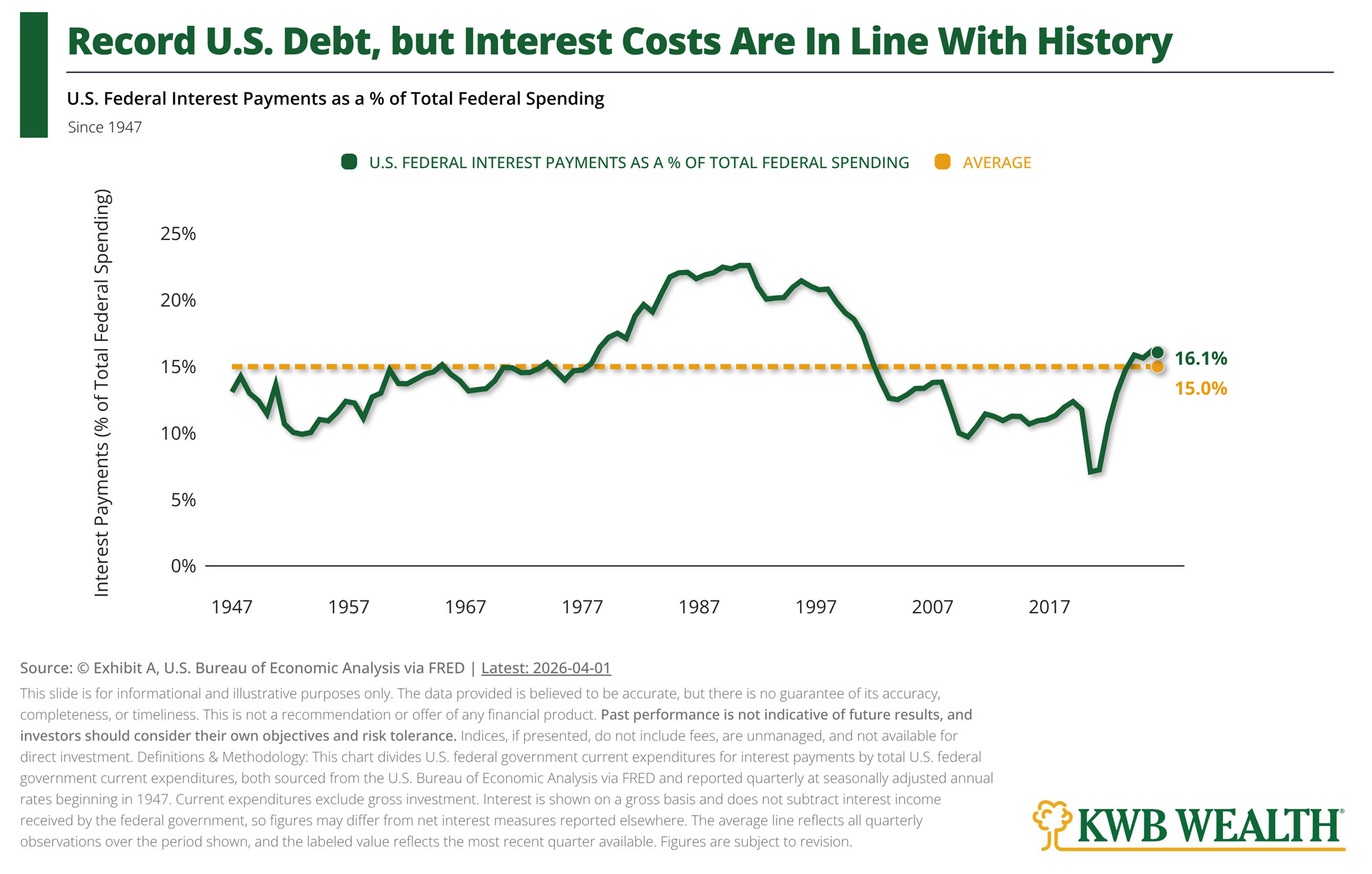
A similar concept can be useful when thinking about government debt. The chart below shows federal interest payments as a share of total federal spending going back to 1947. Today, that figure sits around 16%, against a long-run average of roughly 15%. In the late 1980s and early 1990s, it ran above 20% for years on end.
3 Reasons the Debt Might Affect Your Household
1. Borrowing could get more expensive. Heavy government borrowing tends to put upward pressure on interest rates over time. That shows up in mortgage rates, car loans, home equity lines, and anything else you finance.
2. Deficits are running too hot to ignore. Federal spending is currently about $2 trillion a year ahead of revenue, and that gap is widening during a reasonably healthy economy, exactly when it should be shrinking. The debt crossed $38 trillion last October and $39 trillion in March. The pace is the real problem here, and we hope Washington finds the will to get a handle on it.
3. Interest costs crowd out other choices. Annual net interest costs have passed $1 trillion and now rank as the third-largest expense in the federal budget, behind only Social Security and Medicare. Higher interest costs can reduce the fiscal flexibility available for other government priorities, including tax relief, benefits, or responding to a future recession.
3 Reasons It Probably Won’t Change Your Financial Plan
1. This burden is historically ordinary. Measuring the way a lender would actually measure it, the country has carried this weight before, and for most of the postwar era. The 1980s and 1990s were not decades in which the American economy came apart.
2. Higher rates cut both ways for a retiree. Borrowing becomes more expensive, but certain fixed-income investments may also offer higher yields. If you are drawing income, the yield on the conservative side of your portfolio benefits from the same conditions, and that effect is easy to overlook.
3. Your portfolio isn’t a bet on one fiscal outcome. A mix spread across U.S. and international holdings, across bond maturities, and across different types of assets does not depend on any single result in Washington. That is the whole reason we build diversified portfolios.
The One Move We Discourage? Acting on the headline.
Selling out of a long-term investment plan solely because the national debt crossed a round-number threshold has historically carried the risk of missing subsequent market gains. Nothing about the economy changed on the day the odometer rolled over. Nothing here is a forecast. The debt will keep making headlines, and the next milestone will likely arrive sooner than the last. If the headlines have you questioning whether your financial plan still holds up, that is worth a conversation. We would rather walk through the whole picture with you than leave you sitting with any questions.
~ Steve Gormley
Certain statements herein may be forward-looking and are based on current expectations and assumptions. Actual results may differ materially due to market, economic, legislative, and other factors.
Economic and fiscal data are based on information from the U.S. Department of the Treasury, U.S. Bureau of Economic Analysis via the Federal Reserve Bank of St. Louis (FRED), and Congressional Budget Office. Data is believed to be reliable but is not guaranteed as to accuracy or completeness.
Diversification and asset allocation do not guarantee a profit or protect against loss.